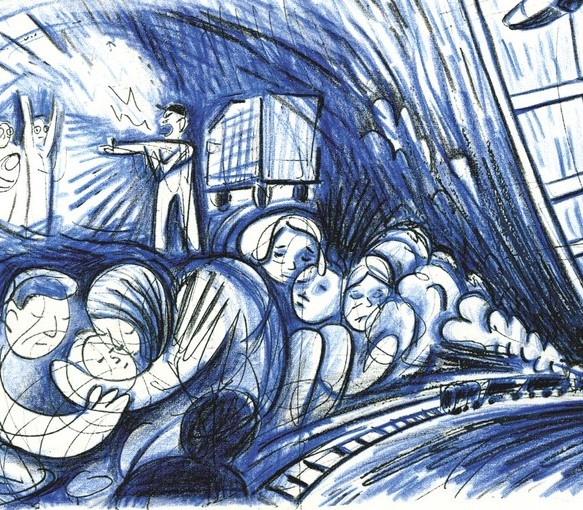
Together with partner institutions in Freiburg, Emmendingen, and Ulm, the IdGL is developing the travelling exhibition “War Endings. What Can We Hold On To?”. At the heart of the project are biographical experiences of flight, life in refugee camps, loss, and new beginnings in the context of the end of the Second World War. The exhibition combines historical research, archival materials, and artistic interpretation in the form of a graphic novel.
The project is of particular importance to the IdGL, as key sources from the institute’s own archive form an integral part of the exhibition. PD Dr. Daniela Simon, project leader at the IdGL, selected the story of Rosina Fath from the institute’s archival holdings and made it one of the biographical core narratives of the exhibition. The chapter is based on memories, photographs, and biographical documents from Rosina Fath’s estate, which were artistically interpreted by the Freiburg-based illustrator Ludmilla Bartscht.
Born in 1929 in Franztal, a Danube Swabian district of Semlin (Zemun, Serbia), Rosina Fath experienced flight, years of life in refugee camps, and the difficult process of building a new life in Austria and Germany as a young woman. The chapter follows her path from the Pannonian plain along the Danube and Sava rivers to the Austrian mountain landscape, experienced as both confining and overwhelming. The contrast between landscapes – openness and confinement, familiar homeland and unfamiliar camps – forms a central narrative layer of the graphic novel.
The exhibition is conceived as a modular travelling exhibition and includes large-scale drawings, exhibition books for browsing, as well as text and image panels. At its centre are eight biographical graphic-novel chapters – most of them focusing on women – that make visible individual experiences surrounding the end of the war in 1945. The artistic works are complemented by historical and cultural contexts, audio and video material accessible via QR codes, and participatory elements that invite visitors to actively engage with cultures of remembrance.
The exhibition asks what people can hold on to in times of war, displacement, and social upheaval and what role memories, rituals, and cultural practices play in creating belonging and social cohesion. Migration is presented not only as a historical experience, but as an ongoing human reality that continues to shape family histories and cultures of remembrance up to the present day.
An exhibition by the Institute for Cultural Analysis of the Germans of Eastern Europe (IKDE), developed in cooperation with the Danube Swabian Central Museum Ulm (DZM), the Institute of Danube Swabian History and Regional Studies (IdGL), and the Friedland Museum (State of Lower Saxony).
The exhibition was designed by Ludmilla Bartscht and curated by Leni Perenčević.
The exhibition is funded by the Baden-Württemberg Foundation and the Schroubek Fund for Eastern Europe.
The exhibition is scheduled to be shown in Emmendingen (June to November 2026), Tübingen (November to December 2026), Ulm (January to March 2027), and Friedland (May to September 2027).